Painting the outside of a house in the North West costs between £900 and £4,500 in 2026. A small terrace with modest frontage sits at the bottom. A detached property needing full scaffolding, render repairs and all woodwork sits at the top.
The spread is wide because exterior work has two costs most people don't anticipate: getting to the surface, and repairing what's underneath it. Here's how the numbers actually break down.
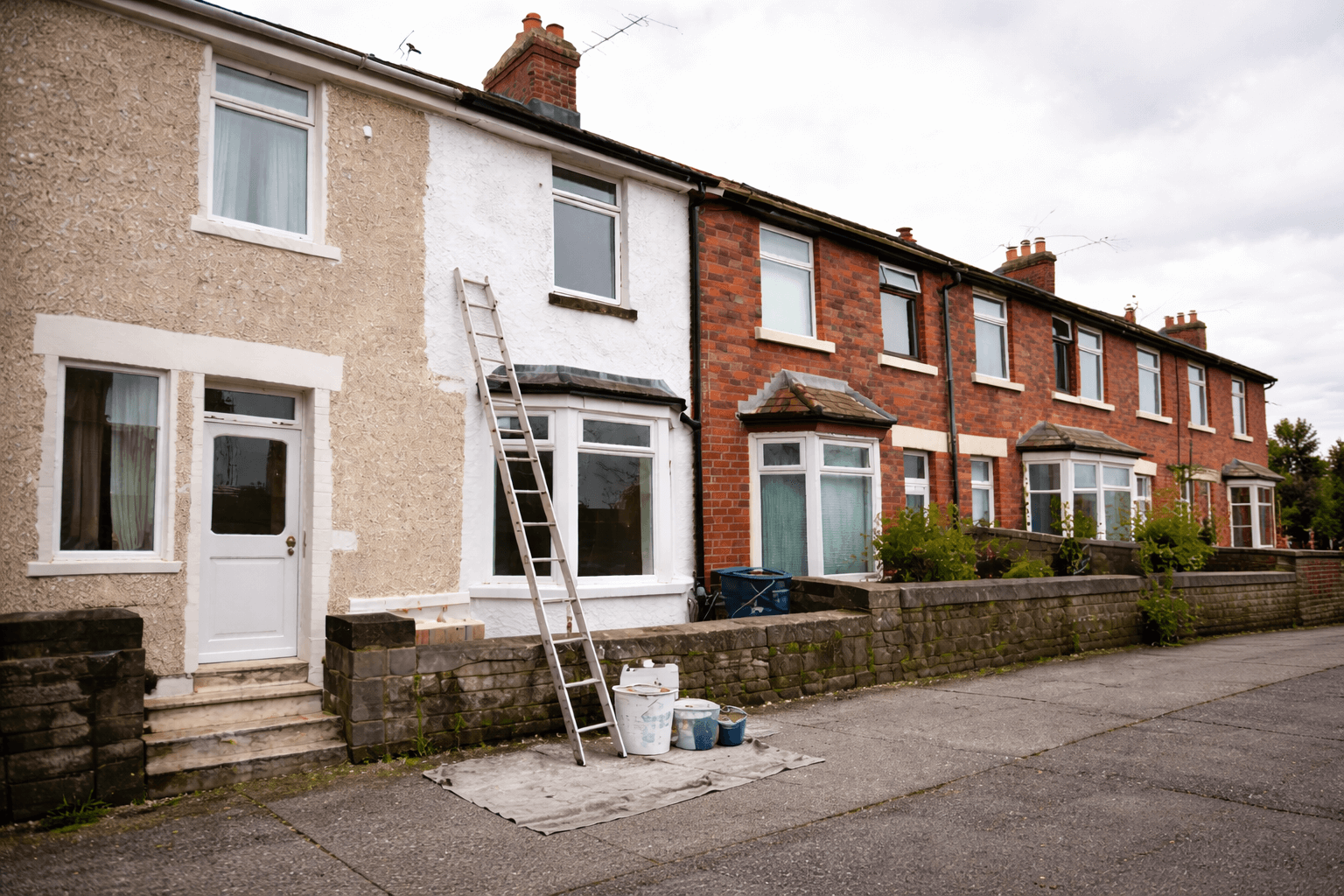
Price guide by property type
| Property | Masonry only | Masonry, woodwork and rainwater goods |
|---|---|---|
| Mid-terrace (front elevation) | £550 – £950 | £900 – £1,600 |
| End-terrace (front and gable) | £900 – £1,600 | £1,400 – £2,400 |
| Semi-detached | £1,200 – £2,100 | £1,800 – £3,200 |
| Detached | £1,800 – £3,200 | £2,600 – £4,800 |
| Bungalow | £900 – £1,700 | £1,400 – £2,600 |
| Individual elements | Typical price |
|---|---|
| Masonry paint, supplied and applied | £14 – £22 per m² |
| Fascias, soffits and bargeboards | £380 – £850 |
| Guttering and downpipes | £180 – £400 |
| Windows, per window (timber, full prep) | £70 – £140 |
| Front door and frame | £130 – £260 |
| Garage door | £120 – £240 |
| Scaffolding hire, semi-detached, 2 weeks | £650 – £1,200 |
| Render crack repair, per m² | £30 – £60 |
North West pricing runs roughly 20–30% under the South East for the same work. National averages published online are usually London-weighted and will make local quotes look suspiciously cheap.
The three things that actually drive the price
Access
This is the cost people forget. Anything above single-storey height needs a tower or scaffold, and on a two-storey semi that's frequently £650 to £1,200 before a brush is lifted. It's a real cost, it's charged at cost by any honest contractor, and it appears as a separate line on the quote.
Where scaffolding is going up anyway, it is always worth doing the fascias, soffits, guttering and upstairs windows in the same visit. Coming back in two years to paint the bargeboards means paying for the scaffold twice.
Terraced properties with rear access down a ginnel — very common in Burnley, Padiham, Nelson and Colne — sometimes can't take a scaffold at the back at all, which changes the method and the price.
Condition of the substrate
Painting is the last 30% of an exterior job. The rest is repair.
- Sound render or pebbledash — wash down, treat any organic growth, fill hairlines, two coats. Straightforward.
- Cracked render — cracks raked out, filled, and where hollow, cut out and patched. Adds £30–£60 per m² over the affected area.
- Previously painted with the wrong product — plastic-heavy masonry paint on solid stone or brick traps moisture. Sometimes it has to come off, and that's a significant job in itself.
- Flaking timber — old paint scraped back, bare timber primed, rot cut out and made good. Rotten window cills are the single most common exterior surprise.
- Organic growth — green and black algae on north-facing walls. Needs a fungicidal wash and time to work before painting, not just a pressure wash.
Surface area, which is not the same as house size
A two-storey semi with a lot of glazing might have less painted wall area than a bungalow with large blank gables. Exterior work is priced per m² of actual coating surface, and the shape of the property matters as much as its footprint.
What should be in an exterior quote
Anything missing here is worth asking about before you sign:
- Access method — scaffold, tower or ladder, and who supplies it
- Preparation stated in detail — washing down, fungicidal treatment, scraping, filling, sanding
- Repairs — render cracks, rotten timber, defective cills, and whether these are included or provisional
- Priming and stabilising — bare masonry needs a stabilising solution; bare timber needs primer
- Product and number of coats — two full coats of masonry paint is standard, three on a colour change
- Rainwater goods — whether guttering and downpipes are included or extra
- Weather contingency — what happens if it rains for a week
- Guarantee — a good exterior system should give eight to ten years on masonry
Product choice and why it changes the price
Standard masonry paint — around £45–£70 for 10 litres trade. Covers roughly 6–8m² per litre over two coats. Good for five to eight years.
Premium flexible masonry — £90–£140 for 10 litres. Bridges hairline cracks and moves with the substrate. Worth it on render that has a history of cracking.
Breathable mineral paint — £120–£180 for 10 litres. Essential on solid stone and older brick where the wall needs to release moisture. Common requirement on the pre-1919 stock across East Lancashire and on older Southport properties. It costs more and it's the right answer where it applies.
Using a cheap plastic masonry paint on a solid stone wall is the classic false economy: it traps moisture in the wall, and within a few years it blisters off, taking the face of the stone with it.
Coastal properties are a different job
Salt-laden air on the Sefton coast — Southport, Birkdale, Ainsdale, Formby — attacks exterior coatings considerably faster than inland conditions. Metalwork corrodes quicker, timber degrades faster, and standard masonry paint doesn't last as long as it does in Burnley.
Realistic repaint cycle on the Sefton coast, against eight to ten years inland — and a stronger case for spending more on the coating up front.
Where the money is best spent
If the budget doesn't stretch to everything at once:
- Timber first. Bare or flaking timber is actively deteriorating. Masonry with tired paint is just tired. Wood rots, walls don't.
- Fascias, soffits and bargeboards next. They're the highest exposure and the most expensive to replace.
- Masonry last. It looks the most dramatic, which is why people want it first, but it's the least urgent.
Want a figure for your own house?
Measured on site, itemised by elevation and element, with access costed separately and honestly.
Getting an accurate figure
Exterior work cannot be priced from a photograph. Rot in a cill, hollow render, or the wrong paint applied ten years ago are all things you find with a ladder and a screwdriver, and all three change the number materially.
We quote exterior work across Burnley, Padiham, Nelson, Colne, Accrington and Clitheroe, and across Southport, Birkdale, Ainsdale, Churchtown and Formby. See our exterior painting services or get a measured quote. If it's the inside of the house you're pricing, our decorating prices for Burnley covers that side of it room by room.