Seven to fourteen days in a normally ventilated room at ordinary temperatures. In winter, in a cold room, or on a wall that's had a full backing coat as well as a finish coat, it can be three to four weeks.
That's the short answer. The longer answer matters, because painting new plaster too early is the single most common and most expensive DIY mistake we get called out to fix — and the fix usually involves taking everything back off.
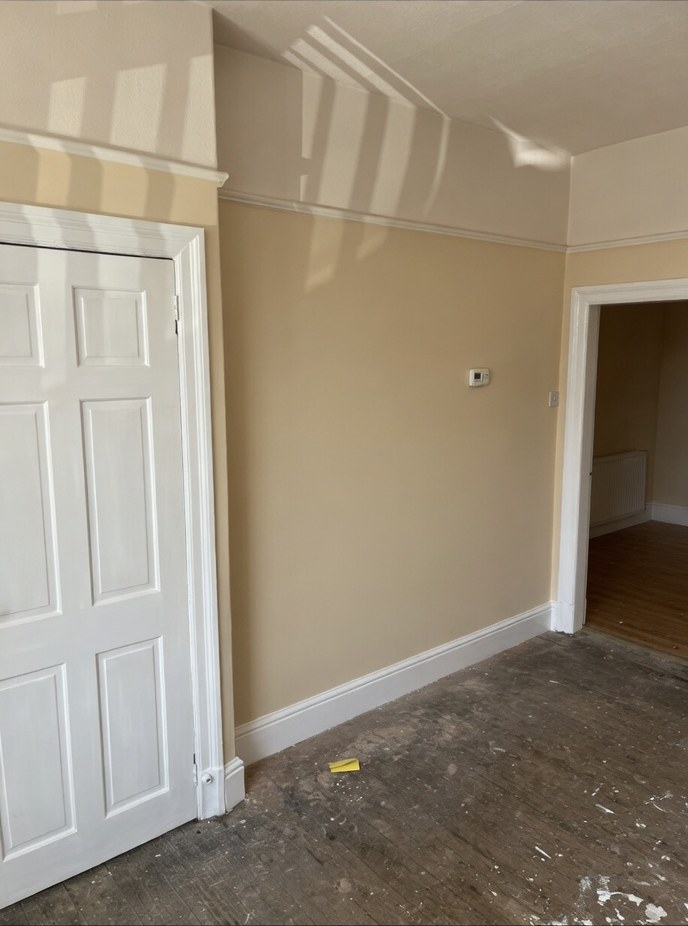
How to tell when it's actually ready
Forget the calendar. Look at the wall.
Fresh plaster goes on a dark, wet brown. As it dries it lightens to pale pink. The entire surface has to be uniformly pale pink — not most of it, not "just a bit darker in the corner". Every square inch.
Dark patches are wet plaster. They're most commonly found:
- In corners, where air movement is poorest
- Behind where furniture or a radiator sits
- Low on external walls
- Around window reveals
- On the wall furthest from the window or door
Those patches are the last to go and they're the ones people paint over because the rest of the wall looks fine.
The tape test. If you want certainty rather than judgement, tape a piece of clear polythene about 300mm square tightly to the wall, sealed on all four edges. Leave it 24 hours. Condensation on the inside of the polythene means the plaster is still releasing moisture and it isn't ready. Repeat every few days until the polythene comes off dry.
Why the timescale varies so much
How thick it is. A 2mm skim over sound existing plaster dries far faster than a full hack-off with a backing coat, which can be 12mm or more of wet material. Skim only: often 5 to 7 days. Full re-plaster: 14 to 28 days.
Time of year. Summer with windows open is fast. November in an unheated room is slow. A cold, still room can double the time.
Ventilation. This is the biggest lever you control. Moving air carries moisture away; still air lets it sit against the wall in a saturated layer.
The substrate. Plaster on a solid external wall — very common in the older Burnley terraces and Southport Victorian stock — dries more slowly than plaster on plasterboard, because the masonry behind it also holds moisture.
Room use. Kitchens and bathrooms generate humidity. Plaster in a bathroom that's being used takes noticeably longer.
Helping it along, and what to avoid
Do
- Open windows on the vent setting, or a crack, day and night where security allows
- Leave internal doors open so air can move through the property
- Use a dehumidifier if you have one — genuinely effective and the fastest safe method
- Put the heating on at a low, steady setting, around 15–18°C
Don't
- Turn the heating up high to force it. This dries the surface while the depth stays wet, and you get cracking and delamination
- Point a fan heater or blower directly at the wall. Same problem, concentrated
- Close the room up to keep the heat in
- Put furniture back against the walls before it's dry
- Take the plasterer's estimate as a guarantee — they're giving you a typical figure, not a reading of your specific room
The mist coat: the step people skip
When the plaster is dry, the first coat is not normal paint. New plaster is porous and thirsty. Full-strength emulsion applied straight onto it sits on the surface, dries too fast to bond properly, and peels off in sheets — often months later, and usually taking a layer of plaster face with it.
A mist coat is emulsion thinned with water so it soaks in and seals the surface.
How to do it
- Use a cheap contract matt or standard white vinyl matt emulsion. Not silk, not one-coat, not anything with additives
- Thin roughly 30% water to 70% paint — 3 parts paint to 1 part water is about right. Aim for the consistency of single cream
- Apply generously with a roller. It will look thin, patchy and unimpressive. That's correct
- Let it dry fully, usually 4 to 6 hours
- Then two full-strength coats of your chosen colour on top
Paint to water for a mist coat — roughly 30% water, thinned to the consistency of single cream.
Some paints are sold as suitable for use directly on new plaster without thinning. Check the tin — but where it doesn't say so explicitly, thin it.
What happens if you paint too early
Three failure modes, all of them expensive:
Peeling and flaking. The most common. Trapped moisture pushes the paint film off the wall. It can happen within weeks or take a year, and by then the room is furnished.
Permanent staining. Moisture carries salts to the surface, which show through the paint as dark or blotchy patches that no number of coats will cover. It needs a stain-blocking primer, and sometimes it needs the plaster back off.
Efflorescence. A white, powdery crystalline bloom on the surface as salts crystallise out. It has to be brushed off dry — never washed — and it will keep coming back until the wall has finished drying.
Putting any of these right costs more than waiting a fortnight.
Timescales at a glance
| Situation | Realistic drying time |
|---|---|
| Skim over sound plaster, summer, well ventilated | 4 – 7 days |
| Skim over sound plaster, winter, poorly ventilated | 10 – 21 days |
| Full re-plaster with backing coat, summer | 14 – 21 days |
| Full re-plaster with backing coat, winter | 21 – 35 days |
| New plasterboard, skimmed only | 3 – 5 days |
| Plaster on a solid external wall | Add 30–50% to the above |
New plasterboard skimmed is quickest of all, because there's no masonry behind it holding water and the board itself absorbs some.
Sequencing a job properly
If you're planning a full redecoration, the order matters:
- Plastering complete
- Drying period — this is when you do floors elsewhere, or nothing at all
- Mist coat
- Woodwork prepared and undercoated
- Ceiling, two coats
- Walls, two coats
- Woodwork finish coats
- Flooring, then furniture back
Trying to compress the drying stage is the point at which most self-managed renovations go wrong. Build the fortnight into the plan rather than trying to find it later.
Plastering and decorating, one job
No waiting for a second trade, and one contractor accountable for the finish. Tell us about the room and we'll plan the drying time in.
Getting it done in the right order
We do plastering and decorating as one job, which removes the gap where you're waiting for a second trade to become available and means one contractor is accountable for the finish. We work across Burnley, Padiham, Nelson, Colne, Accrington and Clitheroe, and across Southport, Birkdale, Ainsdale, Churchtown and Formby.
See how skimming works, plastering costs, or our decorating services.